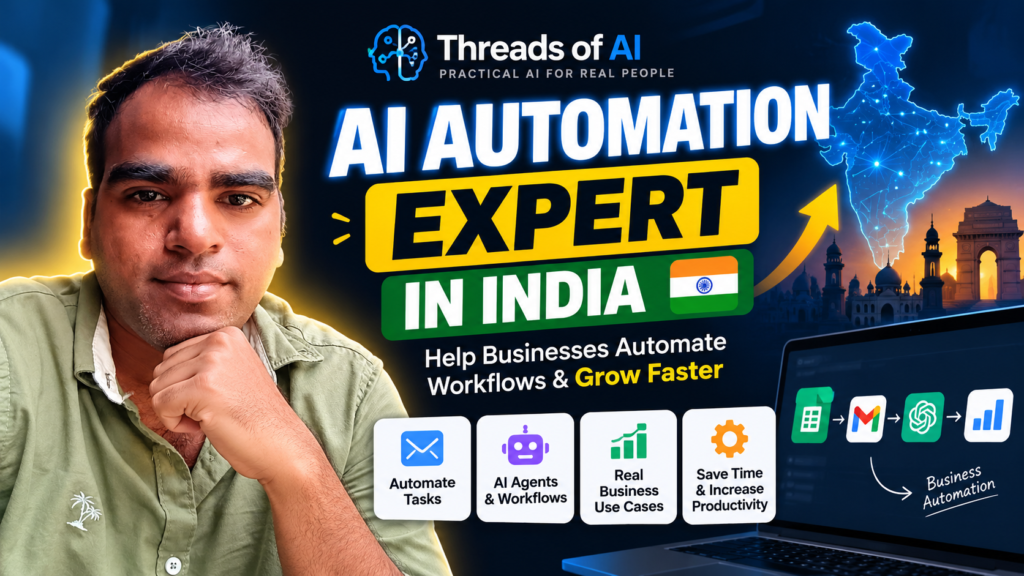
Businesses in India are increasingly exploring artificial intelligence to reduce repetitive work, improve productivity, and streamline daily operations. An AI Automation Expert in India helps businesses identify the right automation opportunities and build workflows that solve real operational problems.
From managing customer inquiries to automating lead follow-ups and business reports, AI automation can help companies work more efficiently. The key is choosing practical solutions that fit existing processes, budgets, and business goals.
In this guide, we explain what AI automation experts do, which services they provide, what tools they use, and how Indian businesses can get started.
Table of Contents
What Does an AI Automation Expert Do?
An AI automation expert combines artificial intelligence, workflow automation, software integrations, and business process knowledge to reduce manual work.
Rather than recommending tools without understanding the problem, a good expert first examines how a business operates and identifies tasks that could be automated safely and effectively.
Common responsibilities include:
- Automating repetitive administrative tasks.
- Connecting applications through APIs and webhooks.
- Building AI-powered customer support workflows.
- Automating lead capture, qualification, and follow-ups.
- Extracting information from documents and organizing business data.
- Creating automated reports and notifications.
- Testing workflows, handling errors, and maintaining integrations.
For example, a business that receives inquiries through its website could automatically capture contact details, categorize each inquiry using AI, save the information in a CRM, and notify the sales team.
This reduces manual data entry and helps employees respond more consistently.
Why Do Indian Businesses Need AI Automation?
Small businesses, startups, agencies, and growing companies often manage multiple processes across spreadsheets, email, messaging platforms, CRMs, and accounting software.
When employees repeatedly transfer information between these tools, valuable time can be lost to administrative work.
AI automation can help address these problems by connecting applications and handling repetitive steps. It can also assist with understanding unstructured information, such as customer messages, emails, and documents.
Here are some practical examples:
- Small businesses: Automate inquiry tracking, appointment reminders, and routine email responses.
- Startups: Streamline lead management, onboarding, and internal reporting.
- E-commerce businesses: Categorize customer support requests and prepare order-related responses.
- Marketing agencies: Automate campaign reports, organize leads, and summarize performance data.
- Service providers: Collect customer information, schedule appointments, and send follow-up reminders.
Automation is not suitable for every task. Processes involving sensitive information, financial decisions, or complex customer situations should include appropriate security controls and human review.
AI Automation Services for Businesses
An AI automation specialist may provide several types of solutions depending on a company’s needs.
1. AI-Powered Customer Support
AI assistants can answer frequently asked questions using approved business information, categorize incoming messages, and direct complex requests to human agents.
Businesses should test these assistants carefully to reduce inaccurate responses and ensure customers can reach a person when necessary.
2. Lead Management and Sales Automation
Lead automation can collect information from website forms, categorize inquiries, update CRM records, and notify sales teams when follow-up is needed.
AI can also help summarize conversations or prepare personalized email drafts for review.
3. Document and Data Processing
AI-powered workflows can extract information from supported documents, classify records, and transfer structured data into business applications.
These workflows can reduce manual data entry, although important information should be validated before it is used for business decisions.
4. Reporting and Business Operations
Automated workflows can collect information from connected tools, prepare summaries, and send regular reports to business owners or team members.
This helps reduce the effort involved in gathering information from multiple sources.
5. Custom AI Agents and Workflow Integrations
Some business processes require more than a simple automation. Custom AI agents can use approved tools and business data to complete multi-step tasks, subject to defined permissions and safeguards.
An experienced AI automation developer can combine APIs, databases, language models, and workflow platforms to build a solution around specific business requirements.
A Practical Example: Automating Lead Management with AI
Consider a small Indian service business that receives customer inquiries through its website.
Without automation, an employee might manually review every inquiry, copy details into a spreadsheet, identify the type of request, and notify the sales team.
A simple AI-powered workflow could work as follows:
- A potential customer submits a website form.
- An automation platform captures the submission.
- An AI model categorizes the inquiry based on predefined criteria.
- The customer’s details and category are saved in a CRM or spreadsheet.
- The sales team receives a notification with a summary.
- A follow-up email draft is prepared for approval or sent automatically under defined rules.
Tools such as n8n, Make, or Zapier can connect the applications, while an AI model handles suitable language-related tasks.
The exact implementation depends on the applications involved, data quality, and business requirements. The workflow should also include error handling, access controls, and a way to review incorrect classifications.
This is the practical value of automation: reducing repetitive steps while keeping people involved where their judgment matters.
Tools Used by AI Automation Experts
The right tools depend on the problem being solved. Common options include:
- n8n: Workflow automation with flexible integrations and options for self-hosting.
- Make: Visual workflow building across supported applications.
- Zapier: Connecting applications through automated triggers and actions.
- AI models and APIs: Text classification, summarization, information extraction, and conversational assistance.
- CRMs and databases: Storing customer records and managing business information.
- Programming languages: Python or JavaScript for custom integrations and more specialized logic.
Businesses should compare pricing, integration support, data handling, reliability, and maintenance requirements before selecting a platform.
Using more tools does not automatically produce better results. A simple, reliable workflow can be more valuable than a complex system that is difficult to maintain.
How to Choose an AI Automation Expert in India
Before hiring a consultant, agency, or developer, evaluate the following factors.
Relevant experience: Look for project demonstrations, working prototypes, or case studies related to your business problem.
Business understanding: A good provider should understand your current workflow before recommending an automation solution.
Technical capabilities: Depending on the project, useful skills may include APIs, webhooks, databases, AI model integration, workflow platforms, and error handling.
Security and reliability: Ask how data is protected, how application permissions are managed, and what happens when a workflow fails.
Measurable results: Define success using indicators such as time saved, fewer manual errors, faster response times, or reduced administrative effort.
Ongoing support: Clarify who will monitor, update, and maintain the workflow after implementation.
The best provider is not necessarily the one offering the most advanced AI technology. It is the one who can design a suitable solution and explain its limitations clearly.
How Much Does AI Automation Cost in India?
AI automation costs vary according to workflow complexity, the number of integrations, development requirements, AI model usage, and ongoing support.
A basic workflow connecting a form to a spreadsheet may be relatively straightforward. A custom AI agent connected to multiple business systems can require substantially more development, testing, security controls, and maintenance.
Before starting a project, businesses should consider:
- Initial development and implementation.
- Automation platform subscriptions.
- AI API usage and other software costs.
- Testing, monitoring, and maintenance.
- Data security and access management.
Ask for a clear project scope and cost estimate. Starting with one small workflow can help a business evaluate its value before expanding to more complex automation.
Frequently Asked Questions
What is an AI Automation Expert in India?
An AI automation expert helps businesses design and implement AI-powered workflows that reduce repetitive tasks, connect software applications, and improve operational efficiency. Services may include workflow development, AI integration, process consulting, testing, and maintenance.
Which businesses can benefit from AI automation?
Small businesses, startups, e-commerce companies, marketing agencies, and service providers can benefit from automating suitable repetitive processes. Common use cases include lead management, customer support, appointment scheduling, reporting, and document processing.
Which tools do AI automation experts use?
Common tools include n8n, Make, Zapier, AI model APIs, CRMs, and databases. The appropriate combination depends on the workflow, required integrations, budget, and security requirements.
Can small businesses afford AI automation?
Many small businesses can start with a simple workflow using their existing applications and an affordable automation platform. Actual costs depend on implementation, software subscriptions, AI usage, and maintenance.
How can I start automating my business?
Identify one repetitive task, document how it currently works, and estimate the time or errors it creates. Then select a suitable tool, test the workflow with limited data, and measure the results before expanding the solution.
Does AI automation replace employees?
Not necessarily. AI automation often supports employees by handling repetitive activities, organizing information, and preparing drafts. Human judgment remains important for complex customer issues, sensitive data, and decisions with significant consequences.
How do I know whether a task is suitable for automation?
A task is often a good candidate when it happens frequently, follows reasonably consistent rules, uses accessible data, and has a measurable outcome. Processes that are unclear or change frequently may need to be simplified before automation.
Conclusion
AI automation can help Indian businesses streamline operations, reduce repetitive work, and make better use of existing software. The most effective approach is to start with a clearly defined problem, select appropriate tools, test the workflow, and measure its business impact.
For businesses exploring AI, the priority should not be adopting every new tool. It should be finding reliable ways to eliminate unnecessary manual work while protecting data and maintaining human oversight.
At Threads of AI, the focus is on making AI practical through useful guides, automation workflows, and real-world applications that help businesses understand how AI can support their work.