Most small businesses don’t need more marketing tools. They need their existing tools to work together.
Think about a lead coming through your website form. Someone needs to check the inquiry, save the details, and follow up. If the team gets busy, that lead can sit unanswered.
The problem isn’t always a lack of tools. Sometimes, the process itself needs fixing.
This is where AI marketing automation can help. You can connect forms, CRM systems, email tools, and AI workflows to reduce repetitive work. But automation needs to solve a real problem. Adding more tools won’t help if the process is already confusing.
So, when does it make sense to hire an AI marketing automation agency instead of building the workflow yourself?
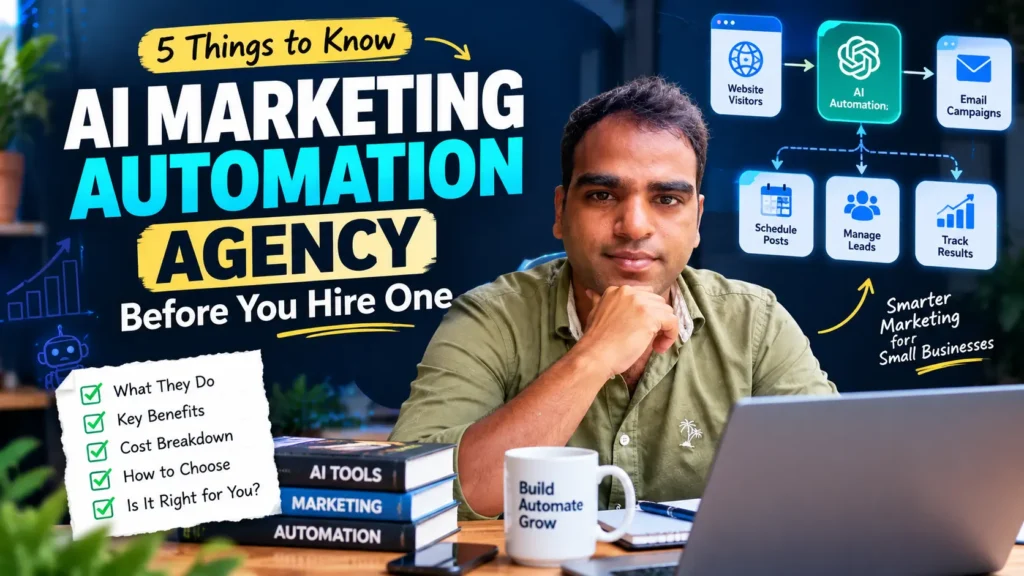
Before spending money, there are five things worth understanding: what an agency actually does, which tasks to automate, how to evaluate its technical expertise, what the setup may cost, and when hiring help makes sense.
Table of Contents
1. What Does an AI Marketing Automation Agency Actually Do?
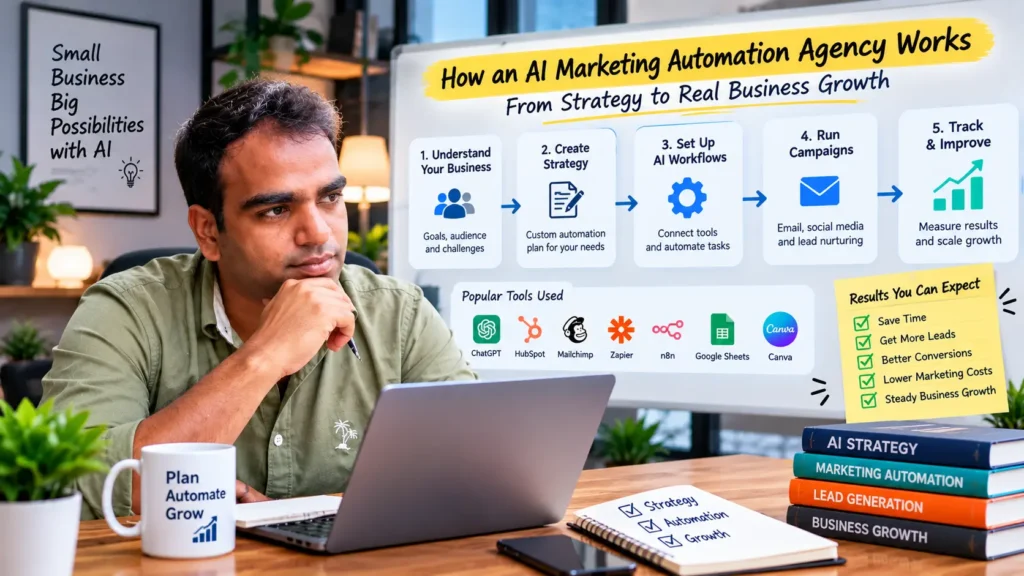
An AI marketing automation agency helps businesses automate repetitive marketing tasks. It connects tools, customer data, and workflows so teams spend less time on manual work.
Take a small business that receives inquiries through its website, Instagram, and email. Someone needs to collect those inquiries, organize the details, and follow up. When these tasks depend on manual work, leads can get missed or responses can be delayed.
An agency can help connect these steps into one workflow.
For example, when someone submits a website form:
- The inquiry is captured and sent to a CRM or spreadsheet.
- The system stores the customer’s details.
- AI helps draft a follow-up email based on the inquiry.
- A team member reviews the message before sending it.
- The system records the follow-up so the team can track what happened.
Notice that AI doesn’t need to handle every step. Standard automation can move data and trigger actions, while AI can help with tasks that involve understanding a message or drafting a response.
An AI marketing automation agency may also help with email campaigns, customer segmentation, content scheduling, and integrations between marketing tools. The right setup depends on the business, its existing tools, and the problem it wants to solve.
Here’s what I’d focus on first: Don’t choose tools before understanding the process. Find out where inquiries come from, how they’re handled, and where delays occur. Then decide which steps are worth automating.
If you want to explore how AI can help qualify leads and manage follow-ups, read our guide to building an AI Sales Agent.
Automation should make the process easier to manage, not add another layer of complexity.
2. Don’t Automate Everything. Start With One Marketing Problem.
When I look at a marketing workflow, I don’t start by asking, “Which AI tool should I use?”
I start with a different question: Which task is taking too much time or causing the most problems?
For one business, it might be answering the same customer questions every day. For another, it could be preparing weekly campaign reports or organizing leads from different channels.
The right starting point depends on the problem, not the tool.
Let’s say a small business spends hours every week preparing marketing reports. The team collects numbers from different platforms, copies them into a spreadsheet, and summarizes the results manually.
Before introducing AI, I’d simplify the process.
- Collect the required metrics in one place.
- Automate data collection where the platforms allow it.
- Use AI to summarize trends or highlight changes.
- Let a team member verify the summary before sharing it.
Notice the order. First, make sure the data is available and reliable. Then decide where AI can help. If the underlying data is incomplete, an AI-generated summary won’t fix the problem.
The same thinking applies to lead management, email campaigns, and customer inquiries. Start with a task that is repetitive, time-consuming, and easy to measure.
Once the workflow runs reliably, check whether it actually saves time or reduces errors. If it does, you can consider automating the next task.
That’s the approach I’d take before investing in a larger automation setup: solve one clear problem, measure the result, and expand only when there’s a reason to.
When discussing a project with an AI marketing automation agency, ask it to explain which problem it plans to solve first and how you’ll know whether the solution is working.
If you’re still choosing which tools to use, explore our guide to AI automation tools for small businesses to compare options for different tasks.
3. Check the Workflow, Not Just the AI Tools
An agency might show you an impressive AI demo. That doesn’t mean the solution is ready for your business.
You might hear about AI agents, chatbots, CRM integrations, or advanced automation platforms. These tools can be useful. But I’d want to understand how they work together and what happens when something goes wrong.
Before hiring an AI marketing automation agency, I’d ask three practical questions.
1. Can they explain the workflow clearly?
Ask the agency to walk you through the process from start to finish. Which event triggers the automation? Where does the data go? Which steps use AI, and which follow predefined rules?
If the explanation is full of technical terms but you still don’t understand what the system will do, ask for a simple workflow diagram.
2. How does the system handle errors?
Integrations can fail. Data may be missing. An API request might time out, or a connected platform could become temporarily unavailable.
Ask what happens in these situations. Does the workflow log the error? Can it retry safely? Will someone be notified if a task fails?
These details matter because a workflow needs to work beyond a successful demo.
3. Where does human review fit in?
AI-generated messages can be inaccurate, irrelevant, or poorly worded. For important customer communications, you may want a team member to review the message before it is sent.
The agency should explain which tasks can run automatically and where human approval is needed.
As a developer, I’d pay attention to these details rather than judging a solution by the number of tools it uses. Connecting apps is only one part of automation. The workflow also needs reliable data handling, error reporting, and a clear maintenance plan.
You don’t need to understand every technical detail yourself. But you should know what the agency is building, how your team will use it, and who will fix problems after launch.
A practical test: Ask the agency to demonstrate one complete workflow, including an example of what happens when a step fails. That will tell you more than a polished demo alone.
4. Understand the Total Cost Before You Hire an Agency
When comparing AI marketing automation agencies, don’t look at the service fee alone. The initial quote may not include every cost you’ll pay later.
Depending on the setup, you may need to pay for software subscriptions, AI usage, integrations, and ongoing maintenance.
For example, a lead follow-up workflow might require a connection between your website form and CRM, an automation platform, and an AI model to help draft responses. Some tools may already be part of your existing subscriptions. Others may add new monthly costs.
Before accepting a proposal, I’d ask for a clear breakdown:
- Setup fee: What exactly will the agency build, configure, and test?
- Software costs: Which subscriptions or usage-based charges will you pay separately?
- Maintenance: Who will monitor the workflow, fix errors, and update integrations?
- Future changes: What will it cost to add another workflow or change the existing setup?
I’d also clarify what happens after launch. Who owns the workflow? Who has access to the connected accounts? And who is responsible if an integration stops working?
These details can make a big difference to the long-term cost.
How Do You Know If the Automation Is Worth It?
I’d define success before the project starts.
Suppose your team spends several hours each week collecting marketing data and preparing reports. After automating parts of that process, track how much time the team still spends on the task.
For a lead management workflow, you could measure response time, missed inquiries, or the number of qualified leads reaching the next stage.
Record the starting numbers, then compare them after implementation. This gives you a more useful basis for evaluating the investment than relying on an agency’s promises.
Keep one thing in mind: saving time doesn’t automatically mean increasing revenue. The result depends on the quality of your process, your leads, and how well the workflow is maintained.
My advice is to start with one measurable problem. Understand the full cost, define the expected outcome, and test the workflow before investing in a larger automation project.
5. Should You Hire an Agency or Build the Workflow Yourself?
I’d make this decision based on the complexity of the problem, not the popularity of the AI tools.
If you run a small business, you probably don’t need an agency for every marketing task. Some workflows are simple enough to build with tools you already use.
For example, you could set up an automatic notification when someone submits a website form. You might also be able to schedule social media posts or organize incoming leads using an existing platform.
If the process is straightforward, start there.
The decision changes when several systems need to work together. You may need to connect your website, CRM, email platform, and AI model. Custom API integrations, error handling, and approval steps can also make the setup more complex.
That’s when an agency or an experienced automation specialist may be worth considering.
Here’s how I’d approach the decision:
- Build it yourself if the workflow is simple, your tools support the required integrations, and you have time to test and maintain it.
- Consider hiring an agency if you need custom integrations, multiple connected systems, or ongoing technical support.
- Start with a small project if you’re unsure whether automation will deliver enough value. Test one workflow before committing to a larger implementation.
Before hiring an agency, ask for a clear scope of work. It should explain what will be built, which tools and subscriptions are required, how success will be measured, and who will handle maintenance.
Make sure your business retains appropriate access to its accounts, data, and workflow configuration. You shouldn’t have to depend entirely on the agency just to understand or access your own setup.
The goal isn’t to automate everything or hire the most expensive provider. It’s to find the simplest reliable solution for the problem you’re trying to solve.
If an existing tool can handle the task well, you may not need a custom AI workflow at all. Spend money on additional complexity only when there’s a clear business reason for it.
Frequently Asked Questions
1. What does an AI marketing automation agency do?
An AI marketing automation agency helps businesses automate repetitive marketing tasks. This can include lead follow-ups, email campaigns, customer segmentation, and connecting marketing tools. The goal is to reduce manual work and make marketing processes more consistent.
2. How much does an AI marketing automation agency cost?
The cost depends on the workflow, tools, integrations, and ongoing support you need. A simple setup will usually require less work than a custom system connecting multiple platforms. Ask for a breakdown of setup fees, software subscriptions, and maintenance before committing.
3. Is AI marketing automation suitable for small businesses?
Yes, especially when a business spends too much time on repetitive tasks. You don’t need to automate everything at once. Start with one clear problem, such as tracking new leads or sending follow-up reminders, and expand when the workflow proves useful.
4. Should I hire an agency or automate marketing myself?
It depends on the complexity of your setup. If you need a simple form notification or basic email workflow, you may be able to build it yourself. If the process involves custom integrations, multiple systems, or ongoing maintenance, an agency may be worth considering.
5. Which marketing tasks can AI automate?
AI can help with email drafts, customer inquiry classification, content planning, lead follow-ups, and campaign reporting. Some tasks can be automated end to end, while others need human review. Choose based on the task, the risk of errors, and the level of control your business needs.
Final Thoughts
You don’t need to automate your entire marketing process on day one.
Start with one task that takes too much time or causes delays. Understand how your current process works, then decide whether automation can make it simpler.
If you need help connecting multiple tools or building a reliable workflow, an AI marketing automation agency may be worth considering. Before hiring one, make sure you understand the total cost, how success will be measured, and who will maintain the system after launch.
My approach would be simple: solve the business problem first and choose the tools second. Automation should make your work easier to manage, not add unnecessary complexity.
If you’d like to explore AI tools, practical workflows, and resources for building an AI-powered business, check out the Threads of AI Power Bundle. It can help you explore your options before deciding which automation solutions make sense for your business.